
We do not have to look far to see the damage sin has done within families. We have seen marriages grow cold and finally break, fathers or mothers become emotionally absent, children feel overlooked, and siblings become estranged. We have seen families divided by addiction, money, jealousy, betrayal, unresolved resentment, or carry wounds from harsh words that can never be taken back. The details may differ, but the pain is familiar. In one way or another, every family has felt the effects of broken relationships.
Ellen White traced this assault on the family in a sobering statement found in The Adventist Home. Writing of the world before the Flood, she identified marriage as a deliberate strategic target of the enemy:
“It was Satan’s studied effort to pervert the marriage institution, to weaken its obligations and lessen its sacredness; for in no surer way could he deface the image of God in man and open the door to misery and vice.”
The Adventist Home, p. 326.1
Did you notice why Satan attacks the family? Because it is one of the most effective means of defacing the image of God in humanity. If that assessment is correct, then the restoration of the family is not a side interest of the gospel; it lies close to its centre.
If the household is where the image of God can be so deeply defaced, it is also where that image can be most visibly restored. Genesis presents the divine likeness in relational terms from the beginning: male and female, blessed together and entrusted with responsibility together. A husband learning to lay down his life, a wife who is honoured and who responds with love and respect, and children being genuinely known rather than merely housed make the character of God visible. Such a home argues for Him more persuasively than words alone, or than any sermon that can be preached. Whatever darkness the enemy has brought over the family, God intends the homes of His people to shine within it – a steady light growing brighter as the great day of the Lord approaches.
In this study, we will trace that theme through two prophets separated by nearly nine centuries: Elijah and John the Baptist. Though they lived in different times, their mission followed the same essential pattern – to call God’s people back to faithfulness, restore obedience to His law, and turn the hearts of parents and children toward one another in preparation for the day of the Lord. That work did not end with John’s death. It continues in the mission entrusted to God’s people at the close of earth’s history: to call hearts back to God and help restore what sin has broken between husbands and wives, parents and children.
Preparing a Highway for a King
Before bitumen, heavy machinery, and modern engineering, building a road fit for a king was exhausting work. A royal highway had to be cut, cleared, and levelled by hand. In some places, metres of rock were carved from a cliff face using little more than basic tools. A smooth and level road never happened by accident; it required deliberate and difficult preparation.
Ancient Israel was familiar with such roads. After leaving Kadesh, Moses sent messengers to the king of Edom seeking permission to pass through his territory. He promised that Israel would remain on “the king’s high way” and would turn “neither to the right hand nor to the left” until they had crossed his borders (Numbers 20:17). Permission was refused, but the expression would have been readily understood: a king’s highway was a prepared route, cleared and maintained for royal or official travel.
Isaiah takes this familiar image – the preparation of a highway before the arrival of a monarch – and applies it to the coming of the Lord:
“Prepare ye the way of the LORD, make straight in the desert a highway for our God. Every valley shall be exalted, and every mountain and hill shall be made low: and the crooked shall be made straight, and the rough places plain.”
Isaiah 40:3–4
Malachi gives the same picture:
“Behold, I will send my messenger, and he shall prepare the way before me: and the Lord… shall suddenly come to his temple.”
Malachi 3:1
But what does it mean to level a road when the terrain is the human heart? Look at this commentary by Ellen White:
“When the Spirit of God, with its marvelous awakening power, touches the soul, it abases human pride… Then humility and self-sacrificing love, so little valued among men, are exalted as alone of worth. This is the work of the gospel.”
The Desire of Ages, p. 135
The mountains represent sinful attitudes like pride, position, and self-importance. The valleys are the places of neglect, absence, and deficiency that have been allowed to remain. The crooked places are patterns of thought and behaviour that have gradually taken a shape God never intended, turning us away from Him and from one another.
This is what it means to prepare a highway for God into the heart. It is the inward work of allowing Him to reshape the life: bringing pride low, raising neglected duties, straightening distorted habits, and making rough relationships plain. The highway is prepared when repentance, confession, humility, and self-sacrificing love are given room to govern the life.
As we’ll see shortly, these prophecies were fulfilled in the life and work of John the Baptist, but they also represent the work of God’s people today.
A Third Prophecy – and a Clue About Timing
Malachi’s closing chapter introduces a third prophecy alongside the two already considered, and this one includes an important clue about when its work is to be fulfilled.
The chapter opens with the coming of a day that will “burn as an oven,” consuming the proud and all who persist in wickedness. This points to the second coming of Christ, when He appears in glory, executes judgment upon the unrepentant, and delivers His faithful people. For those who fear God’s name, that same day brings hope: “the Sun of righteousness” will arise “with healing in his wings.”
Malachi then points in two directions. First comes a call to remember:
“Remember ye the law of Moses my servant, which I commanded unto him in Horeb for all Israel, with the statutes and judgments.”
Malachi 4:4
Then comes a promise concerning a coming restoration of father-child relationships:
“Behold, I will send you Elijah the prophet before the coming of the great and dreadful day of the LORD:
And he shall turn the heart of the fathers to the children, and the heart of the children to their fathers, lest I come and smite the earth with a curse.”Malachi 4:5–6
Two themes are joined here that are often treated separately: a return to God’s commandments and a restoration of relationships within the home. Malachi does not present them as unrelated concerns. The same prophetic work that calls people back to God’s law also turns the hearts of parents (particularly fathers) and children toward one another.
The prophecy is also linked to a definite point in time: this work is to take place before “the great and dreadful day of the LORD”- the second coming of Jesus Christ.
We now have three connected prophecies before us: a voice in the wilderness preparing a highway for God, a messenger sent to prepare the Lord’s way, and an Elijah who restores broken relationships between fathers and children.
The question, then, is this: how does Scripture shows these prophecies were fulfilled in the ministry of John the Baptist, but also point to a final work of preparation before Christ returns?
John the Baptist and the First Fulfilment
Mark identifies the fulfilment of two of these prophecies in the opening verses of his Gospel. He brings together Malachi 3:1- “Behold, I send my messenger before thy face”- and Isaiah 40:3- “The voice of one crying in the wilderness”- and applies both to John the Baptist.
But what of Malachi 4 and its promise that Elijah would come?
The historical Elijah had been taken to heaven centuries before John’s birth. Did Malachi’s prophecy mean that Elijah himself would return from heaven to perform this work?
Jesus Himself gives the answer. Speaking to the crowds about John, He asks what they had gone into the wilderness to see: “A reed shaken with the wind?” or “a man clothed in soft raiment?” He then declares that John was not merely a prophet, but “more than a prophet”- the very messenger foretold by Malachi. Finally, He adds the striking words:
“And if ye will receive it, this is Elias, which was for to come.”
Matthew 11:14
The angel Gabriel had already clarified the nature of this fulfilment before John the Baptist was born. Speaking to Zacharias, John’s father, the angel said that the child would go before the Lord:
“In the spirit and power of Elias, to turn the hearts of the fathers to the children, and the disobedient to the wisdom of the just; to make ready a people prepared for the Lord.”
Luke 1:17
John was not Elijah reincarnated, nor was he the literal Elijah returned from heaven. He came “in the spirit and power of Elias.” His ministry followed the same pattern: he called a nation to repentance, confronted apostasy, turned hearts back to God, and prepared a people to receive the Lord.
John was Elijah in mission, message, and spirit. Just as God’s people will have the same mission, message and spirit as Elijah had. In Testimonies for the Church, vol. 3, p. 61.3 Ellen White wrote,
“[John the Baptist] was a representative of those living in these last days to whom God has entrusted sacred truths to present before the people to prepare the way for the second appearing of Christ.”
Testimonies for the Church, vol. 3, p. 61.3
A Work Still to Come
The prophecy itself suggests this, because Malachi places the coming of Elijah immediately before “the great and dreadful day of the LORD”- the day that “shall burn as an oven.” John truly performed the Elijah work in preparation for Christ’s first advent, but the final day to which Malachi points did not occur during his ministry. The work associated with Elijah therefore remains relevant for those preparing a people for Christ’s return.
The Mount of Transfiguration reinforces this connection. Peter, James, and John saw Jesus transfigured, with Moses and Elijah beside Him (Matthew 16:27–28; 17:1–3). The scene served as a miniature preview of the second coming: Moses, who died and was raised, represented those who will be resurrected at Christ’s return, while Elijah, who was translated without seeing death, represented the living saints who will be changed when He comes. Their presence also echoes Malachi 4, which joins the call to remember the law of Moses with the promise of Elijah before the day of the Lord.
As they descended the mountain, Jesus said, “Elias truly shall first come, and restore all things,” while also explaining that Elijah had already come in the ministry of John the Baptist (Matthew 17:10–13). A genuine fulfilment had occurred, yet the Elijah work of restoration remained relevant in preparation for Christ’s return.
The Work Belonging to God’s People Today
If the Elijah commission still applies, what does it actually involve? Malachi identifies two closely connected elements: the remembrance of God’s law and the turning of hearts within the family.
The Remembrance of God’s Law
Malachi 4:4 connects the promised coming of Elijah with the command:
“Remember ye the law of Moses my servant, which I commanded unto him in Horeb for all Israel”
Malachi 4:4
The commandments God gave Israel at Horeb – Mount Sinai – speak directly to the relationships, loyalties, and responsibilities upon which family life depends. Indeed, most of the Ten Commandments have a direct bearing upon the home.
- The fifth commandment establishes honour, responsibility, and faithfulness between parents and children.
- The seventh protects the marriage covenant and the fidelity upon which the stability of the home rests.
- The tenth reaches beyond outward behaviour to the desires that corrupt marriage and destroy another person’s family.
- The ninth safeguards truthfulness, trust, and reputation – the essential foundations of every healthy relationship.
- The sixth condemns not only the taking of life, but also the hatred, cruelty, and violence that can devastate a household.
- The fourth explicitly includes sons, daughters, servants, and the stranger within the gates, setting apart sacred time for worship, rest, fellowship, and service together.
Seen in this light, the Ten Commandments reveal the kind of relationships that message seeks to restore. A call back to God’s law is also a call back to faithfulness in marriage, responsibility in parenthood, honour between generations, truthfulness, self-control, and love within the home.
The Turning of Hearts
Malachi 4:6 speaks specifically of turning “the heart of the fathers to the children, and the heart of the children to their fathers.” The particular mention of fathers is important. Although both mothers and fathers may fail in their responsibilities, the absent parent in modern society is most often the father. In countless homes, children are being raised without a father’s daily presence, protection, instruction, affection, and example. In other homes, the father may still live under the same roof yet remain largely disengaged – preoccupied with work, entertainment, or personal ambitions. Physical presence alone does not fulfil the prophecy. God desires to turn the father’s heart back toward his children and their children back toward the father.
This turning of the heart involves far more than providing food, clothing, and shelter. A father’s heart is turned when he becomes attentive to the spiritual, emotional, and practical needs of his children; when he listens to them, teaches them, prays with them, disciplines them with patience, and makes them feel that they are worth his time. Children need more than a provider at a distance. They need a father whose character gives them a living picture of the love and presence of God.
The absence of such fatherhood leaves a deep wound. Children may interpret a father’s departure, indifference, or rejection as evidence that they themselves are unworthy of love. Some spend years seeking the approval they never received; others become hardened, distrustful, angry, or vulnerable to unhealthy relationships. Even when children cannot explain the source of their pain, they often carry the effects of fatherlessness into adulthood, marriage, and parenthood.
Yet the prophecy reaches deeper than the relationship between fathers and children. Beneath the estrangement of parent and child often lies the breakdown of the relationship between husband and wife. When parents are divided, distant, hostile, unfaithful, or emotionally detached, the children inevitably feel the instability. A man cannot fully turn his heart toward his children while despising, neglecting, or mistreating their mother. The restoration of fatherhood is therefore closely connected with the restoration of marriage.
The order of restoration is therefore significant. Hearts are first turned back to the Lord. Husbands and wives then learn again to relate to one another with humility, faithfulness, forgiveness, and self-sacrificing love. From that renewed foundation, the hearts of parents and children can also be turned toward one another.
The preparation of a people for the coming of the Lord begins within the family circle, and the restoration of the family begins with individual hearts being restored to God.
Now that we’ve covered this ground, let’s go a bit deeper. To understand why this work is described as an Elijah ministry, let’s briefly return to the crisis Elijah confronted in his own day.
Elijah’s Own Day: A Mixture of the Holy and the Profane
Why was an Elijah figure given this particular work of restoration? Because the crisis Elijah confronted more than 2,500 years ago bears an unsettling resemblance to the spiritual crisis of the last days.
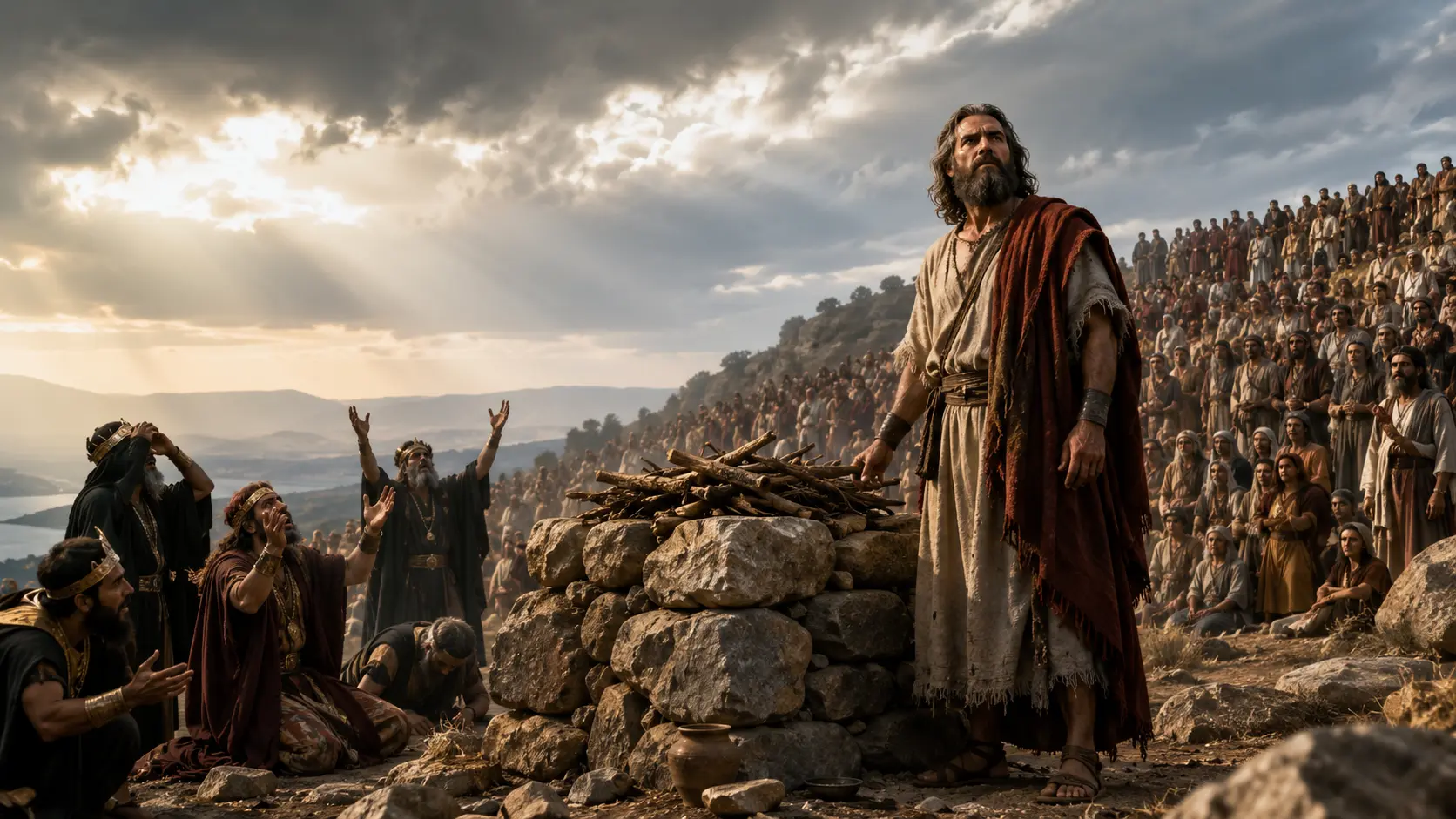
Scripture says that Ahab “did evil in the sight of the LORD above all that were before him.” It was “a light thing” for him to continue in the sins of Jeroboam, so he married Jezebel, the daughter of Ethbaal, king of the Zidonians. Under her influence, Ahab served Baal, built an altar and temple for him in Samaria, and established Asherah worship in Israel (1 Kings 16:30–33). By the time of the confrontation on Mount Carmel, Elijah could summon 450 prophets of Baal and 400 prophets of the groves- associated with Asherah – all supported at Jezebel’s table (1 Kings 18:19).
Baal was worshipped as a storm and fertility deity, while Asherah was associated with fertility, motherhood, and childbirth. A religion centred on fertility could not remain confined to temples and public ceremonies; it inevitably shaped how people understood sexuality, marriage, reproduction, and family life.
Archaeological discoveries show that this religious mixture penetrated deeply into the ordinary homes of Israel and Judah. Excavations at Kuntillet Ajrud in the northern Sinai uncovered inscriptions dating to around the eighth century BC containing blessings such as “Yahweh of Samaria and his asherah.” These inscriptions reveal a disturbing mixture: the name of God Jehovah joined with a pagan creation of Canaanite worship.
Archaeologists have also recovered many small clay female figurines from Judean homes dating to the eighth and early seventh centuries BC. Their sexual features displayed prominently in erotic poses where commonplace in that society.
This was therefore more than a foreign temptation operating at the edges of Israelite society. Pagan religion had entered ordinary household life. The worship of Jehovah was blended with beliefs and practices that shaped marriage, sexuality, parenthood, and the desire for prosperity and children. The holy and the profane were being mixed not only at public altars, but within the home itself – in the daily beliefs, fears, desires, and practices of Israelite families.
What the Mixture Did to the Family
Fertility religion distorted the meaning of sexuality by detaching it from its God given role, into a religious system concerned with securing rain, harvests, offspring, and material prosperity. Rather than understanding sexual union within the covenant of marriage and the faithful giving of one person to another, worshippers could associate fertility and sexual symbolism with attempts to influence the gods.
Once sexuality was absorbed into idolatrous worship and separated from God’s covenant design, it become easier to treat it instrumentally – as a selfish means of obtaining pleasure, fertility, power, or prosperity rather than as the pure expression of love, faithfulness, and lifelong union.
Furthermore, such a religious world encouraged the belief that family misfortune – particularly the illness or death of a child – was divine punishment for parental sin, sometimes driving parents toward acts of sacrificial appeasement. We see something of this reflex in an unexpected place. When the son of the widow of Zarephath became sick and stopped breathing, her first response was to ask Elijah, “Art thou come unto me to call my sin to remembrance, and to slay my son?” (1 Kings 17:17–18). Notwithstanding this woman was a follower of the light she had about the true God, she was also still in ground zero of paganism, and no doubt influenced by the superstitions of her society.
“How Long Halt Ye Between Two Opinions?”
This is the setting in which Elijah’s challenge on Mount Carmel is understood. Standing before the assembled nation, he asks a single, searching question:
“How long halt ye between two opinions? if the LORD be God, follow him: but if Baal, then follow him.”
1 Kings 18:21
The people “answered him not a word” (1 Kings 18:20–21). They were unwilling to reject the Lord completely, yet equally unwilling to abandon Baal. Their silence exposed the nation’s divided loyalty.
Elijah’s prayer at the time of the evening sacrifice reveals the purpose of the entire confrontation:
“Hear me, O LORD, hear me, that this people may know that thou art the LORD God, and that thou hast turned their heart back again.”
1 Kings 18:37
Notice who turns the heart. Elijah speaks plainly, exposes error, rebuilds the altar, and prays – but the inward work belongs to God. Elijah could call the people to choose, but only God could restore their affections. Truth must be spoken, but hearts cannot be forced; they must be won and turned by God.
Elijah’s commission, then, was to call Israel out of the confusion created by blending pagan practices with the worship of Jehovah and to restore undivided loyalty to God. This restoration could not remain confined to the altar. As fathers and mothers returned to God, their understanding of marriage, sexuality, parenthood, and responsibility could also be brought back into harmony with His design. The healing of the family began with the healing of the heart, and the healing of the heart began with a return to God. That pattern brings the Elijah message directly into the present.
The Question for Today
Could the same mixture of the holy and the profane be taking place within Christianity today? Does Scripture warn that, before Christ returns, professed believers will retain the appearance of religion while embracing attitudes and practices that weaken marriage, wound children, and dismantle the family?
Paul’s description of the last days answers this clearly. He warns Timothy that “perilous times shall come,” and then describes people who are lovers of themselves, covetous, proud, blasphemous, disobedient to parents, unthankful, unholy, “without natural affection, trucebreakers, false accusers, incontinent, fierce,” and lovers of pleasure more than lovers of God (2 Timothy 3:1–5).
The final phrase reveals the setting of the entire list:
“Having a form of godliness, but denying the power thereof.”
2 Timothy 3:5
Paul is not merely describing open unbelief. He is describing people who retain a religious profession while resisting the transforming power of the gospel. Notice how devastating these characteristics are to family life: the language of faith remains, but its influence over character and relationships has been emptied out. This is strikingly similar to the crisis Elijah confronted – the name of God preserved, yet His claims upon the life compromised by destructive worldly values.
Two expressions in Paul’s list are especially relevant to the family.
“Without natural affection” translates the Greek astorgoi. The word refers to the absence of the natural love ordinarily expected among members of a family – the affection of parents for children, children for parents, and relatives for one another. In fact, this Greek word also refers to the basic instinctual care and protection animals display for their young. The absence of this natural affection points to a hardening of the heart in the very relationships where tenderness, loyalty, and protection should come most naturally. Is not this the sad condition of so many families?
“Trucebreakers” translates a word carrying the sense of being irreconcilable or unwilling to make peace. It describes those who resist reconciliation, refuse to forgive, and remain fixed in hostility. Within a family, that spirit can turn conflict into estrangement, disagreement into lasting bitterness, and wounded relationships into permanent divisions.
Paul is equally direct elsewhere:
“But if any provide not for his own, and specially for those of his own house, he hath denied the faith, and is worse than an infidel.”
1 Timothy 5:8
In its immediate context, Paul is here speaking of the duty to provide practical care for one’s family. Yet his language establishes a broader principle: religion that neglects the members of your own family contradicts itself. A man may profess faith publicly – even teach it to others, but if that faith produces no responsibility, presence, compassion, or faithfulness toward members of his own family, the profession is denied by the life. Children need more than money and material provision; they also need affection, presence, instruction, protection, and spiritual nurture. The Elijah message therefore speaks directly to the responsibility of parents – and particularly to fathers, whom Malachi explicitly calls to turn their hearts toward their children.
The crisis of the last days, and the restorative work of Elijah in response to it, therefore enters directly into the home. It is seen in neglected duties being taken up again, broken promises being redeemed, hardened relationships being softened and restored, and a mere form of godliness giving way to the transforming power of true religion – the power to produce genuine love.
Conclusion
The work entrusted to God’s people today is the same work represented by Elijah: to turn hearts back to God and, through that restoration, to rebuild the family relationships the enemy has been seeking to destroy since the Fall. It is a monumental task, and honesty requires us to admit that it lies beyond our natural strength. Sinful people cannot, by willpower alone, heal sinful families.
But God has never called His people to a work He has not also promised to empower. John carried out his ministry “in the spirit and power of Elias”- that is, through the Spirit and power of God. The same Spirit who humbled pride, exalted self-sacrificing love, and turned Israel’s heart back to God on Mount Carmel is still able to turn the heart of a father toward his child, a child toward a parent, a husband toward his wife, and every one of us toward our Father in heaven.
If a mountain of pride, self-interest, resentment, or old pain stands between you and someone in your family, let this be the day it begins to come down. If there is a valley of neglect, absence, silence, or estrangement in your home, let this be the day it begins to be filled. If there are crooked patterns of blame, harshness, or avoidance, let this be the day they begin to be made straight.
A highway is never prepared by accident. The ground must be faced, cleared, and levelled. Yet we do not undertake that work alone. God calls us to surrender, repent, forgive, speak truth in love, and take the first faithful step – and He promises to work within us, turning hearts and restoring what sin has broken.
Let us prepare the highway for God, into our hearts.
In the next part of this series, we will examine the marriage covenant more closely: why marriages fail, what leads to divorce, and how husbands and wives can preserve the union God intended to remain intact.